
Understanding SDF Test Results
How to Interpret Your Exact & Extend SDF Test Results
Your Sperm DNA Fragmentation (SDF) test results provide valuable insights into your reproductive health. Whether you’ve had the Exact or Extend test, understanding your results is key to making informed decisions about your fertility journey. This guide explains what your scores mean, how they compare to fertile ranges, and what steps you can take next. Explore the detailed breakdowns below to interpret your results with confidence.
What Do Your Exact Results Mean?
The results on this page are examples only, and your individual results will be different.
- Low sperm DNA fragmentation means the quality of the sperm is good
- Medium sperm DNA fragmentation means the quality of sperm is moderate
- High sperm DNA fragmentation means the quality of sperm is poor
Average Sperm DNA Fragmentation (SDF) score: Fertile vs. Infertile Range
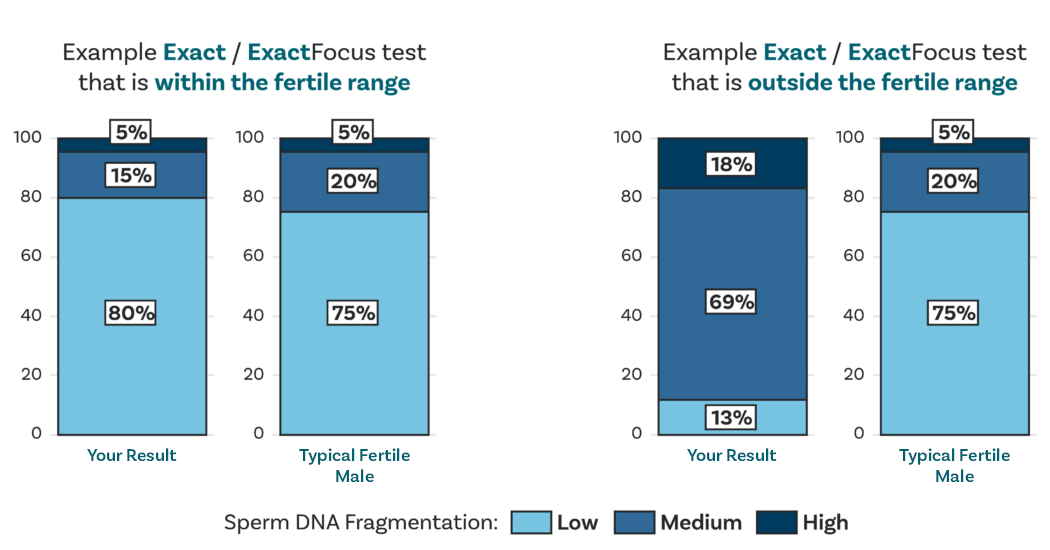
An Average SDF score from 0%-31% is within the fertile range, whereas a score greater than 31% is outside the fertile range and has an increased risk of infertility.

% DNA Fragmentation Category: Comparing to a Fertile Male
The split of your sample between each DNA fragmentation category can be directly compared to that of a typical fertile male, providing further insight into how the DNA fragmentation is distributed in your sample.
DNA Fragmentation Distribution: A Detailed Breakdown
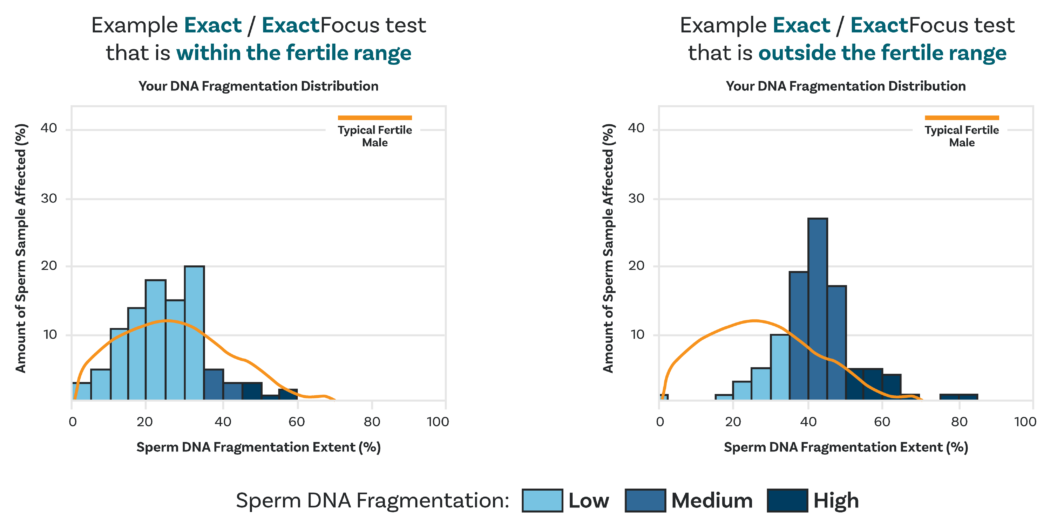
The DNA Fragmentation Distribution histogram provides a more comprehensive view of the distribution of damage across your sample.
The width of each of the columns shows the extent of the SDF damage category (e.g. 20-25% damaged) and the height of each column shows the proportion(%) of your sample that has that damage extent.
Additionally, the profile of a typical fertile male is also shown superimposed onto your results so you can see how your SDF damage distribution compares.
What Do Your Extend Results Mean?
The results on this page are examples only, and your individual results will be different.
- Low levels of sperm double-stranded DNA fragmentation mean the quality of sperm is good
- Medium levels of sperm double-stranded DNA fragmentation mean the quality of sperm is moderate
- High levels of sperm double-stranded DNA fragmentation mean the quality of sperm is poor
Average Double-Stranded SDF score: Fertile vs. Infertile Range
An Average Double Stranded SDF score between 0% to 6% is within the fertile range, whereas a score greater than 6% is outside this range and has an increased risk of infertility.

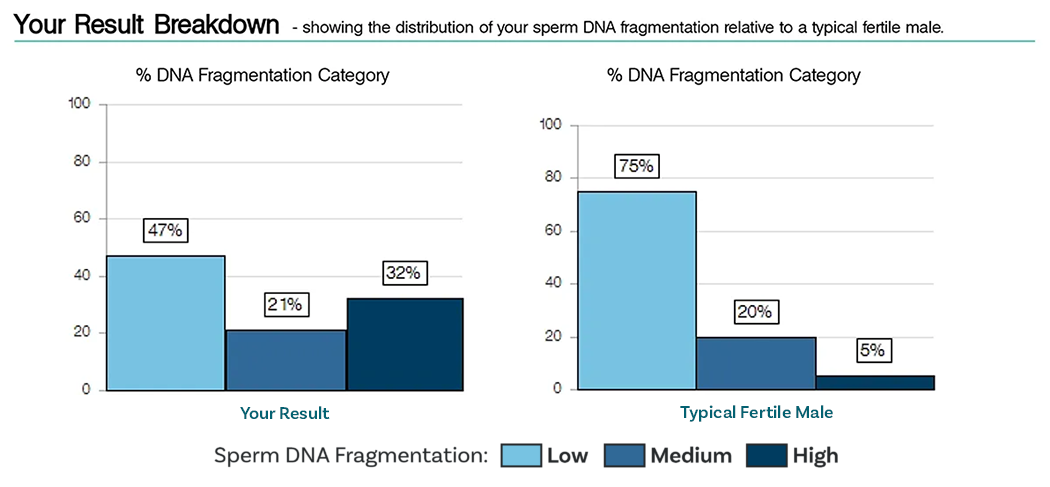
% DNA Fragmentation Category vs a Fertile Male
The split of your sample between each DNA fragmentation category can be directly compared to that of a typical fertile male, providing further insight into how the DNA fragmentation is distributed within your sample.
Can You Improve Abnormal SDF Results?
Sperm DNA damage can occur in two forms: single-strand DNA breaks and double-strand DNA breaks (dsDB).
Single-strand DNA breaks have been linked to lifestyle factors such as smoking, alcohol consumption, recreational drug use, anabolic steroid use, and poor diet. These breaks may also indicate underlying medical issues, such as a varicocele (a varicose vein in the scrotum) or an infection, so an abnormal result can indicate a need for a more in-depth male health assessment. Making positive lifestyle changes, such as improving your diet or reducing harmful habits, may help improve sperm DNA quality. Learn more about improving sperm DNA quality.
Double-strand DNA breaks, on the other hand, are generally more severe and are thought to result primarily from errors during sperm production. However, there is some evidence to suggest lifestyle factors such as caffeine intake are associated with higher levels of dsDB damage in sperm1.
If your results indicate abnormal levels of DNA damage, your fertility expert is best placed to guide you. They can discuss potential solutions tailored to your situation, such as sperm selection techniques, genetic testing of embryos, or, in some cases, the use of donor sperm. Remember, every case is unique, and your doctor will provide the most appropriate advice for your fertility journey.
- T.E. Schmid, B. Eskenazi, A. Baumgartner, F. Marchetti, S. Young, R. Weldon, D. Anderson, A.J. Wyrobek, The effects of male age on sperm DNA damage in healthy non-smokers, Human Reproduction, Volume 22, Issue 1, 1 January 2007, Pages 180–187, https://doi.org/10.1093/humrep/del338 ↩︎